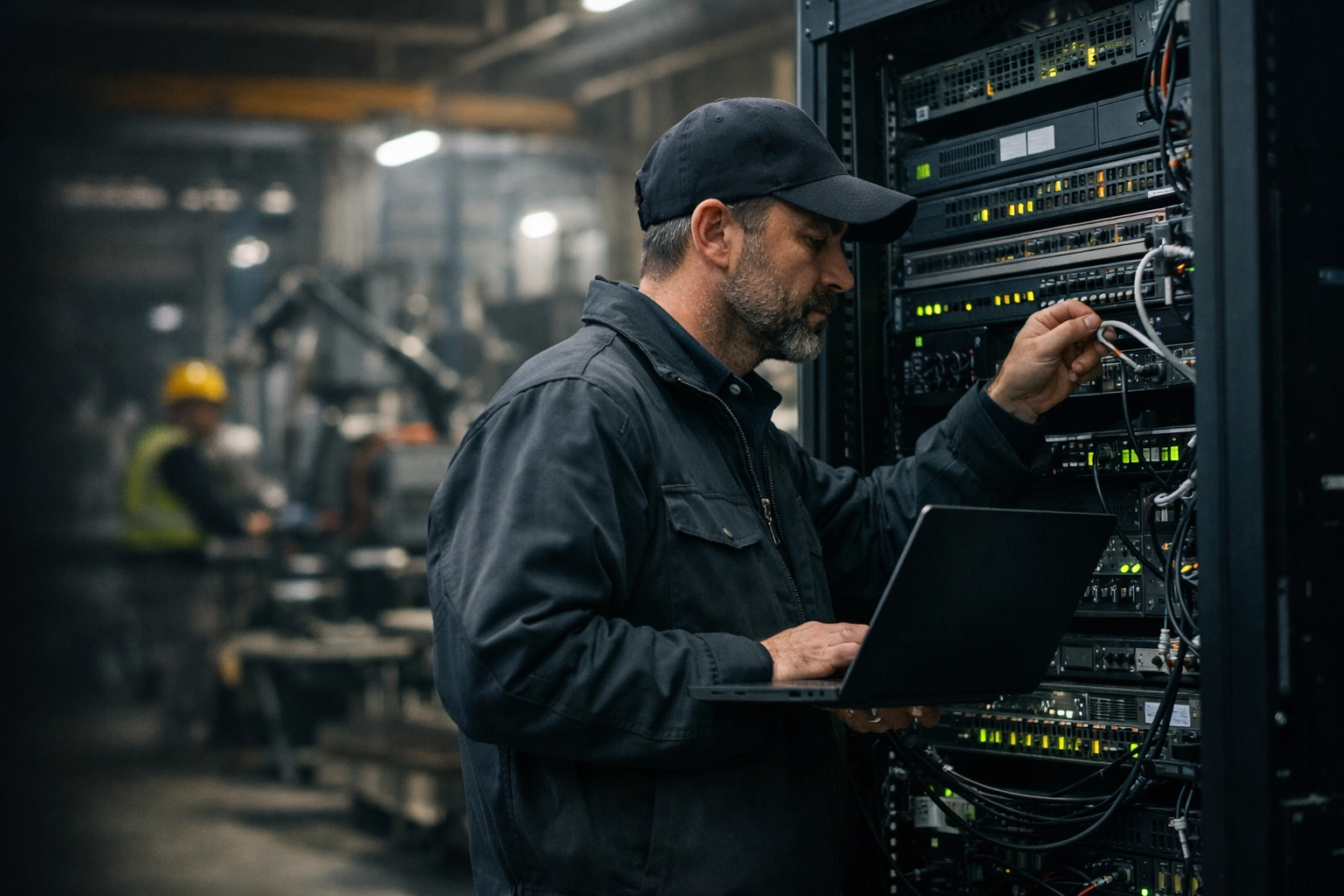
In the Nebraska manufacturing world, uptime isn't just a metric. It’s the heartbeat of the business. When the line stops in a Grand Island fabrication plant or an Omaha food processing facility, the clock starts ticking in dollars, thousands of them every hour. Yet, most manufacturing leaders are sitting on a ticking time bomb.
You likely have an "IT guy" or a standard service provider who told you that you’re "covered." You have a firewall. you have antivirus. You might even have backups. But here’s the uncomfortable truth: standard IT security is built for offices, not for the shop floor.
Ransomware isn't just looking for your spreadsheets anymore. It’s looking for your PLCs, your CNC controllers, and your industrial IoT sensors. If your cybersecurity strategy hasn't evolved to meet the specific demands of Cybersecurity Services Nebraska manufacturers require, you aren't protected. You're just lucky. For now.
At SAINT Technology Services, we see the gaps that others ignore. We’re not here to sell you a shiny new app; we’re here to stabilize your operations. Here are 10 reasons why your current ransomware protection is likely to fail when you need it most.
1. You’re Treating IT and OT as the Same Thing
Standard IT security measures, like the ones used in a Lincoln law firm, don’t work on the production floor. Operational Technology (OT) has different performance constraints. You can’t just run a heavy antivirus scan on a legacy controller without risking a system crash.
When your network treats your office computers and your production machinery as one big pool, a single infected email in the accounting department can jump straight to your assembly line. Without specialized manufacturing security, your ransomware protection is essentially a screen door in a hurricane.
2. The "Ghost" in the Machine: Unmanaged Vendor Access
Think about how many vendors have remote access to your systems. The guys who maintain the HVAC, the technicians who calibrate your precision lathes, and the software vendors for your ERP system.
Manufacturers often grant broad, persistent network access to third parties for "maintenance." If one of those vendors gets breached, the hackers use their credentials to walk right into your network. We’ve seen aerospace suppliers compromised through a simple maintenance vendor’s remote portal. If you aren't monitoring who is in your house and what they are touching, you don't have security.
3. Your Backups Ignore the Production Reality
Most Managed IT Services Lincoln NE providers back up your files and your emails. That’s great for the office. But what about your PLC configurations? What about the historical data and integration parameters that keep your specific machines talking to each other?
We’ve seen plants hit by ransomware where the office was back up in a day, but the production floor stayed dark for a week because the critical configuration files weren't in the backup rotation. Rebuilding a production scheduling system from scratch is a nightmare that costs hundreds of thousands in lost contracts.
4. Total Blindness to the Shop Floor
You can’t protect what you can’t see. Research shows that a staggering 86% of organizations have little to no visibility into their OT environments. If an intruder is moving through your network, they aren't going to announce themselves. They’re going to sit quietly, map out your systems, and find the one machine that will hurt the most if it stops.
Without continuous monitoring specifically tuned for industrial protocols, you are flying blind. By the time you notice the ransomware, the damage is already done.
5. Legacy Hardware: The Open Back Door
Manufacturing is unique because we use equipment that is designed to last 20 or 30 years. Your server might be new, but the machine it controls might be running on Windows 7, or worse.
These legacy systems are full of holes. They weren't designed with the modern internet in mind. Many industrial IoT devices come with default passwords that can't be changed and security protocols that haven't been updated since the Bush administration. If your IT provider isn't specifically hardening these legacy endpoints, they are leaving the back door wide open.
6. Unaddressed Known Vulnerabilities
Nearly half of all attacks in the manufacturing sector happen because of vulnerabilities that everyone already knew about. These are "unpatched" holes in software.
In a busy plant, patching is a headache. It requires downtime. So, it gets pushed off. "We'll do it next quarter," becomes "We'll do it next year." Hackers know this. They aren't always using high-tech "zero-day" exploits; they’re using the digital equivalent of a broken window that you've been meaning to fix for months.
7. You’re Reactive Instead of Proactive
If your IT strategy is "call us when it breaks," you’ve already lost the ransomware war. Reactive security only responds after the breach. In manufacturing, that means your machines have already stopped.
A proactive approach involves 24/7 threat detection. You need eyes on the network on Sunday night at 2 AM, because that’s when the attackers strike. They want to ensure no one is around to pull the plug when the encryption starts. If you don't have a team like SAINT providing Cybersecurity Services in Lincoln, NE, you're waiting for a disaster to happen.
8. Lack of Network Segmentation
This is the single biggest failure we see in Nebraska manufacturing plants. A flat network is a playground for ransomware.
In a flat network, once a hacker gets into one computer, they have access to everything, the payroll, the design files, and the machine controllers. Proper network segmentation creates digital "firewalls" between departments. If the front office gets hit, the shop floor stays isolated and running. Without this, one bad click can bankrupt the company.
9. The Human Element: Training Fatigue
You can have the best firewall in the world, but it won't stop an employee from clicking a link that looks like a "shipping manifest" or an "invoice."
Standard "once-a-year" security training doesn't work. It’s boring, and people forget it five minutes after it's over. Manufacturing environments are fast-paced and high-stress. People make mistakes. If your security relies on your tired employees never making a mistake, your security is non-existent.
10. Inadequate Incident Response (IR) Plans
When the screens go red and the machines stop, what is the first thing your team does? If the answer is "panic" or "call the IT guy and wait for a call back," you’re in trouble.
Most manufacturers lack a rapid containment and recovery procedure designed for the shop floor. Every minute you spend wondering what to do costs thousands. An effective IR plan identifies exactly who does what, which systems get priority for restoration, and how to communicate with customers while you’re down.
How SAINT Solves This for Nebraska Manufacturers
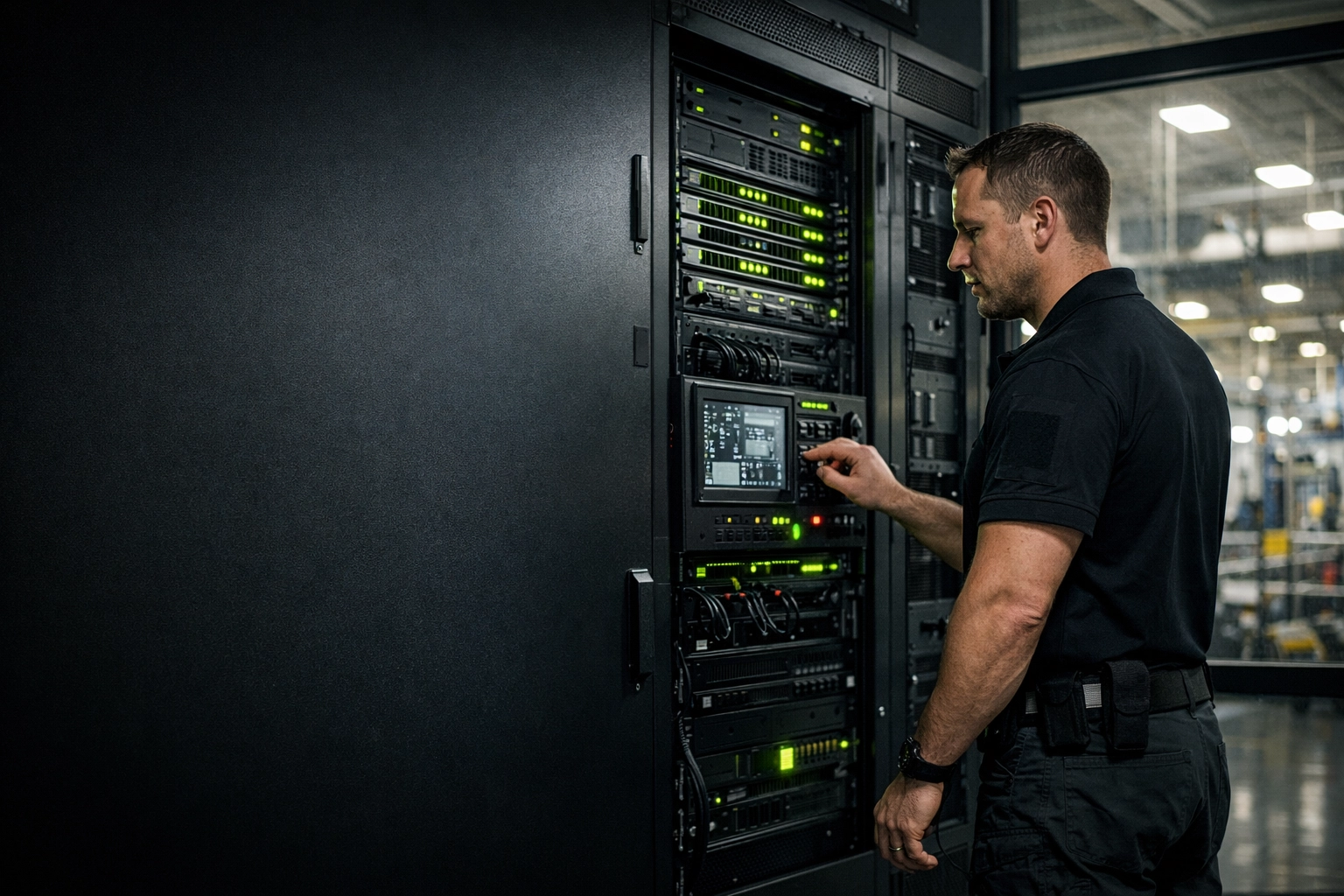
At SAINT Technology Services, we don’t just "do IT." We provide a disciplined, tactical approach to technology that prioritizes production continuity. We understand that for a business in Omaha or Lincoln, downtime is a dirty word.
We act as your converged technology partner. This means we look at the whole picture, from the firewall in your server room to the access control on your front door and the cameras watching your loading dock.
Our Stabilize-Manage-Optimize Process:
- Assess: We identify the hidden vulnerabilities in your OT and IT environments. No fluff, just the facts.
- Stabilize: We implement network segmentation and robust backups that include your critical machine configurations.
- Manage: We provide 24/7 monitoring and a helpdesk that actually answers the phone.
- Optimize: We look for ways to cut recurring overhead, like switching to license-free camera architecture and unifying your systems to save you money.
We are a veteran-owned, Nebraska-rooted team. We don’t do "surprise" invoices, and we don't speak in corporate buzzwords. We provide the Cybersecurity Services in Omaha, NE that businesses actually need to stay profitable and secure.
FAQ: Manufacturing Cybersecurity in Nebraska
Q: Why is manufacturing targeted more than other industries?
A: Because manufacturers have a lower tolerance for downtime. Hackers know that if they stop your production line, you are much more likely to pay the ransom quickly to get back to work.
Q: Can I just use my current IT company for OT security?
A: Only if they have specific experience with industrial protocols and shop-floor environments. Most standard MSPs are out of their depth when it comes to PLCs and legacy industrial hardware.
Q: How much does ransomware protection cost?
A: At SAINT, we offer flat-rate monthly pricing. It’s significantly less than the $274,000 average cost of a single manufacturing breach.
Q: Do I need to replace all my old machinery to be secure?
A: No. We can use network segmentation and specialized hardware to "wrap" your legacy machines in a protective layer, keeping them secure without requiring a multi-million dollar equipment upgrade.
Q: How fast can SAINT respond if we have an issue?
A: We pride ourselves on being a fast, local Omaha Managed IT Provider. We don't believe in ticket queues that last for days. We fix it before it becomes a problem.
Q: What is the first step to securing my plant?
A: A vulnerability assessment. You need to know where your "broken windows" are before you can fix them.
Related Services:
- Managed IT Services
- Industrial Network Infrastructure
- Unified Physical Security (CCTV & Access Control)
- Disaster Recovery & Business Continuity
Serving Businesses in Nebraska:
We proudly support manufacturing and industrial facilities in Lincoln, Omaha, Bellevue, Fremont, Grand Island, Kearney, and Norfolk.
If your business in Lincoln or Omaha is dealing with slow systems, downtime, or unreliable IT support ( SAINT fixes it before it becomes a problem.)